

POLICY INFLUENCING

The AYJ has grown into an alliance of over 70 non-profit organisations working together to drive positive change in youth justice for the benefit of children and society.
We advocate for distinct systems, services and support that treat children as children first and foremost - underpinned by social justice, children’s rights and a focus on positive long-term outcomes. Our work focuses on influencing policy, legislation and practice to address issues affecting children who come into conflict with the law - from diversion and policing to custody and resettlement.
How we work
As an alliance, AYJ is in a unique position to drive policy change. We provide a network for exchanging ideas and co-producing publications, working proactively and reactively in collaboration with our members. We have a strong track record as an influential group informing and influencing improvements to the youth justice system.
Our priorities
Our priority issues for policy influencing are driven by our vision, mission, purpose and principles. Our strategy, developed in conjunction with our members, sets out the areas we focus our proactive work on, as well as determining our priorities for responding to policy and legislative developments from Government.
Our work
View all AYJ publications here, and the work for our projects on the impact of COVID-19, our Young Advocates, and the Young Women’s Justice Project here. See details of our latest written responses, briefings, comments, events and more below.
AYJ Responses, Submissions, Briefings and Publications:
AYJ Comment:

This AYJ comment responds to a series of recent youth justice developments, including the Youth Justice Statistics 2024–25, the IMB’s annual report on HMYOI Feltham, and the Government’s response to the Justice Committee’s youth custody recommendations. It recognises continued reductions in the number of children entering the system and in custody, while raising concerns about unsafe conditions and calling for greater urgency, ambition and transparency in reform.
This AYJ comment responds to the government’s policy statement A Modern Youth Justice System: Foundations Fit for the Future. It welcomes signs of progress while setting out the need for ambitious reform to make custody a genuine last resort, reduce unnecessary remand, and move away from unsafe custodial environments towards child-centred approaches.
This AYJ comment responds to the High Court ruling on the use of PAVA spray in YOIs. It sets out our deep disappointment at the decision and reiterates the urgent need to move away from harmful, punitive responses towards small, therapeutic forms of custody, used only as a last resort.
This AYJ comment piece looks at the Justice Committee’s Ending the cycle of reoffending - part one: rehabilitation in Prisons report. In the short term, we see further accountability on these issues as a welcome first step. In the long term, the best way to meet the needs of children and support desistance is to ensure that no child is sentenced or remanded to custody unless it is an absolute last resort and for the shortest appropriate period.
This AYJ comment piece welcomes the government’s announcement of a dedicated sentencing review for children and calls for the government to take meaningful steps towards meeting children’s distinct needs. This includes ensuring that custody is only ever used as a last resort.
The government’s response to the Hancock Review sets out initial commitments but lacks long-term ambition to ensure the needs of girls in custody are met
In our latest comment, we respond to the inspection of HMYOI Feltham A, where violence remains the highest of any prison, and children face long lock-ups and disrupted education. Despite small improvements at the institution, we warn that these findings reflect a wider crisis in safety across the youth estate.

This blog, in conversation with a youth worker for The Children’s Society (TCS) in Nottinghamshire, examines how TCS helps children and young adults affected by child criminal exploitation.
In our latest comment, we respond to the inspection of HMYOI Feltham A, where violence remains the highest of any prison, and children face long lock-ups and disrupted education. Despite small improvements at the institution, we warn that these findings reflect a wider crisis in safety across the youth estate.
AYJ comment on removal of children from Oasis Restore secure school, highlighting serious safety failings and warning against transfers to unsafe YOIs and STCs, reiterating calls for custody to be a last resort and delivered only in small, local, welfare-based settings with high standards of care and safety.
AYJ comment on urgent notification for Oakhill STC and inspection of HMYOI Werrington, warning of institutional failure across the youth secure estate and calling for STCs and YOIs to be replaced with small, local, Child First environments rooted in care, wellbeing and safety.

In this blog, we speak to Zahbia Yousuf at Maslaha — a grassroots organisation new to AYJ membership. Maslaha work to challenge the root causes of Islamophobia. Zahbia reflects on how the education system fails to meet the needs of racialised young people, the importance of creative, culturally responsive spaces, and why change must be shaped by those most affected.
AYJ comment on HMI Prisons’ thematic report Building trust, calls for the closure of YOIs highlighting Secure Children’s Homes provide the best environment for building relationships that support children in custody’s wellbeing and safety and enable them to fulfil their potential.
The AYJ shares our position on the recent Independent Sentencing Review by David Gauke. We ask that the Government now considers how best to protect children from the harms of imprisonment.

AYJ CEO, Jess Mullen, writes to update our members and partners — reflecting on what we’ve been working on together so far this year and looking ahead to what’s coming up next.
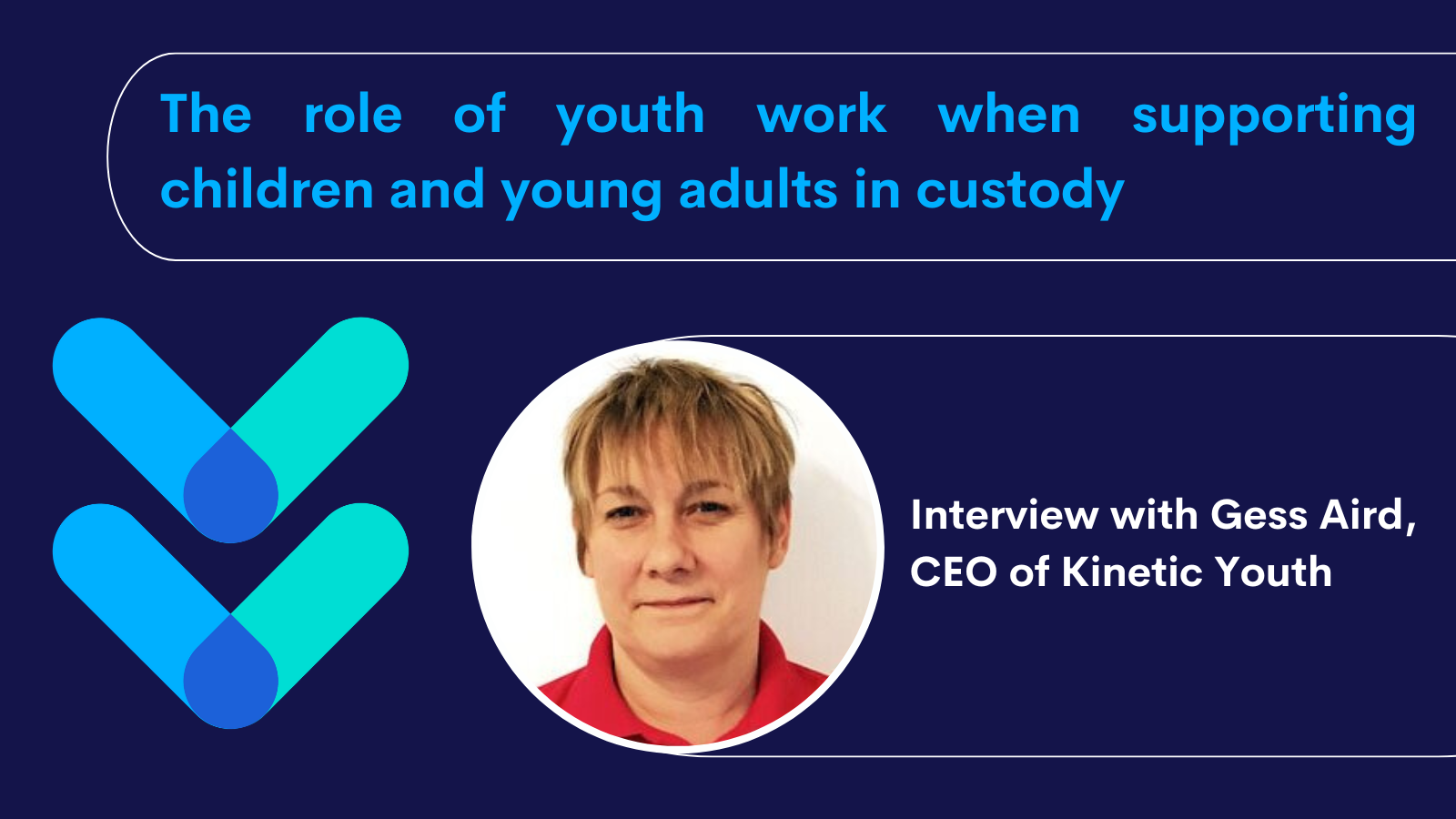
In this blog, Gess Aird, the CEO of Kinetic Youth speaks to the rich history of youth work in the UK and outlines how those methodologies inform the important work Kinetic do with children and young people caught up in the secure estate.

In this blog, Laura Janes, from AYJ member the Youth Practitioners’ Association, asks what it will take to create a well-resourced secure estate that caters to the distinct needs of children and young adults.
The AYJ shares our position after the government recently stated vulnerable girls sentenced to youth custody will no longer be placed in Young Offender Institutions (YOIs).

In this analysis piece, John Drew CBE, AYJ board member and former CEO of the YJB, reflects on the decision to change the age young people transition to the adult estate from 18 to 19.

AYJ comment on HMI Prisons’ reports Children in Custody 2023-24 and Feltham A YOI Independent Review of Progress

AYJ CEO Jess Mullen reflects on the importance of this year’s Black History Month theme ‘Reclaiming Narratives’ for Black and racially minoritised children in, or at risk of involvement in, the youth justice system
AYJ comment on HMI Prisons’ progress review on the separation of children in Young Offender Institutions
Our statement following racist riots across the UK and subsequent arrests, including of a significant number of children
A deeply concerning inspection report on conditions in Feltham YOI demonstrates the urgent need for youth custody reform. The newly announced Crime and Policing Bill is a crucial opportunity to keep children out of the failing secure estate
AYJ comment on HMI Prisons’ inspection report on Wetherby Young Offender Institution (YOI)
AYJ comment on HMI Prisons’ annual Children in Custody report and an inspection report on Werrington YOI, exposing deeply concerning conditions within the secure estate for children
A new policy framework sets out that staff in the children’s secure estate are no longer permitted to use techniques to restrain children which deliberately cause pain.

Over 30 organisations working with & on behalf of children and young adults in criminal justice system have called on Youth Justice Minister Damian Hinds to act over the appalling treatment of children in the secure estate.

AYJ Policy Manager Millie Harris reflects on the UN Committee on the Rights of the Child (UNCRC)’s report on the UK’s performance on it’s international obligations on children’s rights, which calls out the Government for a lack of progress on youth justice.
AYJ Explains:

The government has introduced the Sentencing Bill to Parliament. Here, we summarise proposals which will impact children in the youth justice system

The government has introduced the Criminal justice Bill to Parliament. We explain proposals which if passed into law will impact children in, or at risk of entering, the youth justice system

The Police, Crime, Sentencing and Courts (PCSC) Bill fails to address burning injustices in our youth justice system caused when a child turns 18. Here, the AYJ sets out recommendations to improve the Bill and ensure children are treated as children.

Clause 136 of the Police, Crime, Sentencing and Courts (PCSC) Bill proposes reforms to criminal records. Here, the AYJ examines these reforms and sets out our recommendations.

Clause 131 of the Police, Crime, Sentencing and Courts (PCSC) Bill proposes changes to the use of remand for children. Here, the AYJ examines these changes and sets out our recommendations.

While the AYJ has numerous concerns across many different aspects of the Police, Crime, Sentencing, and Courts Bill, we have narrowed these down to three principal concerns regarding the impact on children’s rights as set out by the UN Convention on the Rights of the Child (UNCRC). These are the ways in which the Bill fails to treat children as children, will increase the incarceration of children, and exacerbate racial disparities.

Clauses 7-21 of the Police, Crime, Sentencing and Courts Bill introduce a multi-agency ‘Serious Violence Duty’. Here, the AYJ examines the Duty and our recommendations for change.
Clauses 100-106 of the Police, Crime, Sentencing and Courts Bill propose changes to child custody. Here, the AYJ examines these changes and sets out our recommendations.

Clauses 166-169 of the Police, Crime, Sentencing and Courts (PCSC) Bill proposes an expansion of video links in court. Here, the AYJ examines these proposals and sets out our recommendations.

Clause 135 of the Police, Crime, Sentencing and Courts (PCSC) Bill proposes reforms to community sentencing. Here, the AYJ examines these reforms and sets out our recommendations.

The Police, Crime, Sentencing and Courts (PCSC) Bill will further entrench racial disparities and continue to reduce public trust and confidence in the criminal justice system. Here, the AYJ examines the Bill on the grounds of racial inequality and sets out our recommendations.
AYJ Meetings and Events:
On 24th October we hosted our Quarterly Members’ Meeting, which featured a presentation from Alan Webster, Head of the Youth Justice Policy Unit at the Ministry of Justice.

On Tuesday 19th April, the AYJ hosted our quarterly Members’ Meeting, featuring the Executive Director of the Youth Custody Service Ed Cornmell. Read more about the meeting here.

On Tuesday 24th January, the AYJ hosted our quarterly Members’ Meeting, featuring the Children’s Commissioner for England Rachel de Souza, and her Director of Policy, Planning and Delivery Juliette Cammaerts.
The AYJ speaks with Charlie Sutton, co-ordinator and social researcher for new research on ‘context sensitive preventative interventions’ within youth justice.
Our quarterly Members’ Meeting featured a panel on the harms posed to children by stop and search, with an emphasis on strip searching. Panellists were Yolanda Lear, Project Officer at Hackney Account; Dr Ian Joseph, Research Associate at the Open University; and Chris Bath, Chief Executive at the National Appropriate Adult Network.

The AYJ hosted a meeting between the Ministry of Justice and AYJ members and the Young Advocates, to help the Ministry of Justice advise Ministers about the recommendations in the Independent Care Review.

Alongside Agenda, the AYJ has concluded the ‘Young Women’s Justice Project’ with a parliamentary event to explore the policy implications of the project’s findings.

In continuation with our research project, conducted collaboratively with the Manchester Centre for Youth Studies at MMU and funded by UK Research and Innovation, we hosted a parliamentary event exploring how to ensure that the criminalisation of children is a last resort post-pandemic.

Join AYJ and the Manchester Centre for Youth Studies on Wednesday 27th April where the findings from the UKRI-funded research project will be presented, hosted at Manchester Metropolitan University.

AYJ’s first Members’ Meeting of 2022 focused on the urgent action required to address the worsening racial disparity in the youth justice system.

The AYJ and our members joined with the Education Select Committee to inform the next stages of their inquiry into Prison Education and an opportunity for members to help shape the priorities of the committee’s inquiry relating to children and young people.

Back in March, to mark our relaunch as the Alliance for Youth Justice (AYJ), we held an event which questioned how we could reimagine ‘justice’ for children. Watch the event highlights here!

In collaboration with press regulator, IMPRESS, AYJ held a consultation with our members on what best practice for media reporting on children and youth justice should look like. It was an opportunity to share experiences of children’s interactions with and portrayals in the media.

Join us in our launching event for the AYJ, as we ask the question ‘how could we reimagine ‘justice’ for children?’ - the first in a series of #AYJasks…